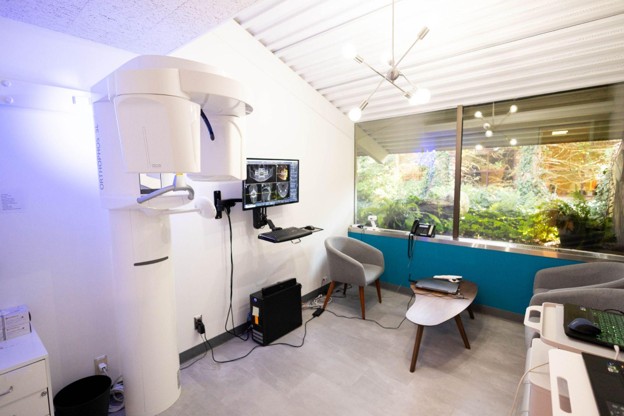
Sometimes a traditional dental X-ray doesn’t tell the whole story. At Restore Dental Arts, cone beam computed tomography (CBCT) gives our doctors a three-dimensional view of the teeth, jawbone, nerves, and surrounding structures when additional detail is needed to plan treatment.
Unlike traditional X-rays, which capture a flat image, CBCT creates a 3D image that can be viewed from multiple angles and examined in thin slices. This helps our doctors better understand each patient’s anatomy before recommending certain procedures.
Why Is 3D Imaging Important for Dental Implants?
CBCT is particularly valuable when planning dental implant treatment. Before placing an implant, our doctors need to evaluate the available bone, identify important anatomical structures, and determine the appropriate implant position.
This detailed view is especially helpful when planning full-arch restorations, such as our Onyx Solution, which uses four or more dental implants to support a full arch of replacement teeth. Careful planning helps our team evaluate each patient’s needs and coordinate implant placement with the final restoration.
CBCT can also assist with complex root canal cases and oral surgery by revealing root anatomy and the location of nerves and other structures.
Better Information for More Informed Care
CBCT isn’t necessary for every patient or procedure. Our doctors recommend 3D imaging when the additional information can meaningfully assist with diagnosis or treatment planning.
At Restore Dental Arts, we combine advanced imaging, clinical experience, and restorative expertise to plan treatment around each patient’s unique needs. Whether you’re considering a single dental implant or a full-arch restoration with the Onyx Solution, detailed planning is an important part of creating a functional, natural-looking smile.