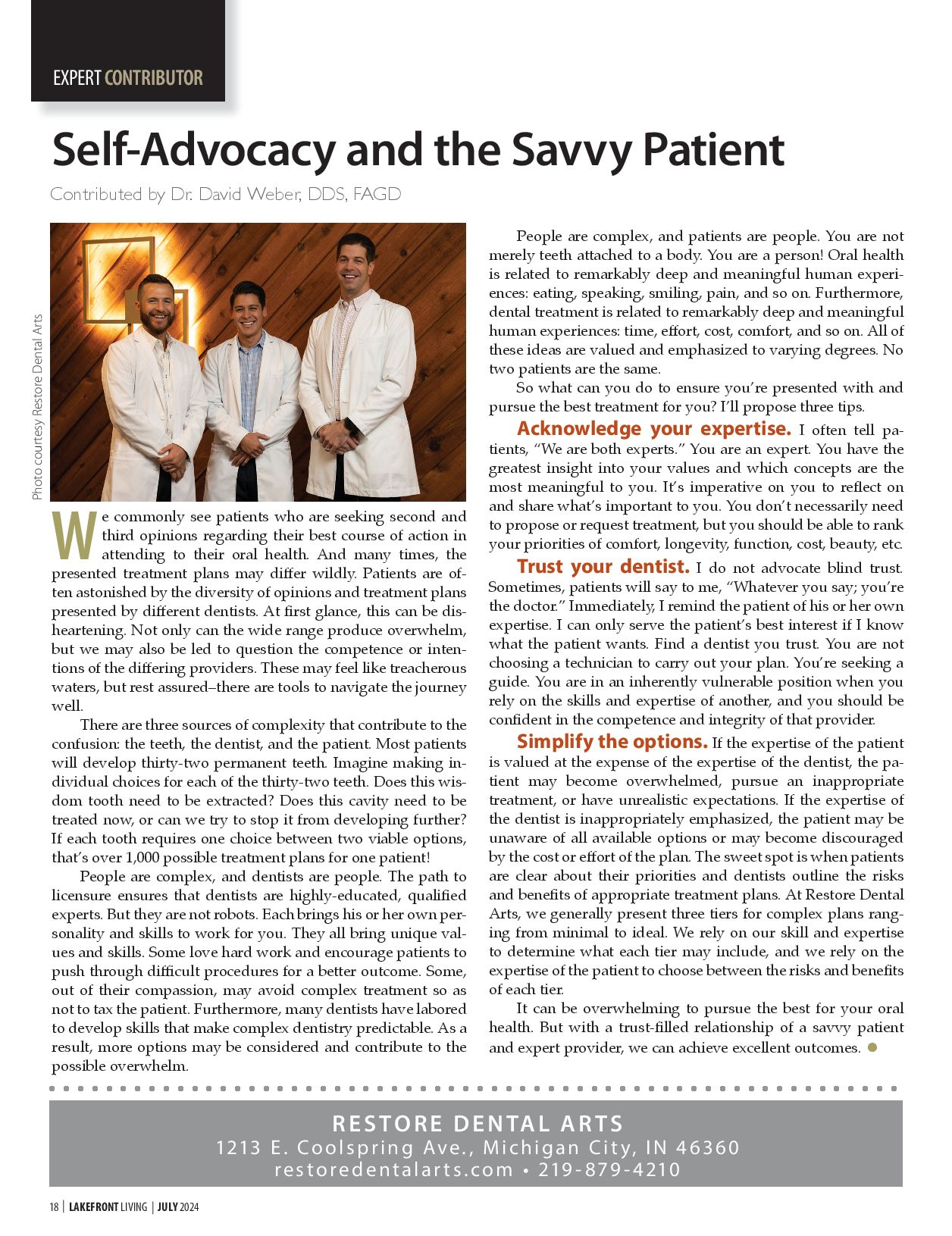
Contributed by Dr. David Weber, DDS, FAGD
We commonly see patients who are seeking second and third opinions regarding their best course of action in attending to their oral health. And many times, the presented treatment plans may differ wildly. Patients are often astonished by the diversity of opinions and treatment plans presented by different dentists. At first glance, this can be disheartening. Not only can the wide range produce overwhelm, but we may also be led to question the competence or intentions of the differing providers. These may feel like treacherous waters, but rest assured—there are tools to navigate the journey well.
There are three sources of complexity that contribute to the confusion: the teeth, the dentist, and the patient. Most patients will develop thirty-two permanent teeth. Imagine making individual choices for each of the thirty-two teeth. Does this wisdom tooth need to be extracted? Does this cavity need to be treated now, or can we try to stop it from developing further? If each tooth requires one choice between two viable options, that’s over 1,000 possible treatment plans for one patient!
People are complex, and dentists are people. The path to licensure ensures that dentists are highly-educated, qualified experts. But they are not robots. Each brings his or her own personality and skills to work for you. They all bring unique values and skills. Some love hard work and encourage patients to push through difficult procedures for a better outcome. Some, out of their compassion, may avoid complex treatment so as not to tax the patient. Furthermore, many dentists have labored to develop skills that make complex dentistry predictable. As a result, more options may be considered and contribute to the possible overwhelm.
People are complex, and patients are people. You are not merely teeth attached to a body. You are a person! Oral health is related to remarkably deep and meaningful human experiences: eating, speaking, smiling, pain, and so on. Furthermore, dental treatment is related to remarkably deep and meaningful human experiences: time, effort, cost, comfort, and so on. All of these ideas are valued and emphasized to varying degrees. No two patients are the same.
So what can you do to ensure you’re presented with and pursue the best treatment for you? I’ll propose three tips.
Acknowledge your expertise. I often tell patients, “We are both experts.” You are an expert. You have the greatest insight into your values and which concepts are the most meaningful to you. It’s imperative on you to reflect on and share what’s important to you. You don’t necessarily need to propose or request treatment, but you should be able to rank your priorities of comfort, longevity, function, cost, beauty, etc.
Trust your dentist. I do not advocate blind trust. Sometimes, patients will say to me, “Whatever you say; you’re the doctor.” Immediately, I remind the patient of his or her own expertise. I can only serve the patient’s best interest if I know what the patient wants. Find a dentist you trust. You are not choosing a technician to carry out your plan. You’re seeking a guide. You are in an inherently vulnerable position when you rely on the skills and expertise of another, and you should be confident in the competence and integrity of that provider.
Simplify the options. If the expertise of the patient is valued at the expense of the expertise of the dentist, the patient may become overwhelmed, pursue an inappropriate treatment, or have unrealistic expectations. If the expertise of the dentist is inappropriately emphasized, the patient may be unaware of all available options or may become discouraged by the cost or effort of the plan. The sweet spot is when patients are clear about their priorities and dentists outline the risks and benefits of appropriate treatment plans. At Restore Dental Arts, we generally present three tiers for complex plans ranging from minimal to ideal. We rely on our skill and expertise to determine what each tier may include, and we rely on the expertise of the patient to choose between the risks and benefits of each tier.
It can be overwhelming to pursue the best for your oral health. But with a trust-filled relationship of a savvy patient and expert provider, we can achieve excellent outcomes.