Contributed by Dr. Michael Kirk, DDS
In our past articles, we have highlighted the recent advancements in dental technology and patient comfort. In this article, we will demonstrate how these techniques facilitate dental implant treatment. With the full arsenal of diagnostic tools, we are able to accomplish what used to take ten visits in as few as four. This is because we can now create a digitized patient avatar and begin with the end in mind. Furthermore, the digital records are preserved throughout treatment, whereas analog records are often destroyed during fabrication.
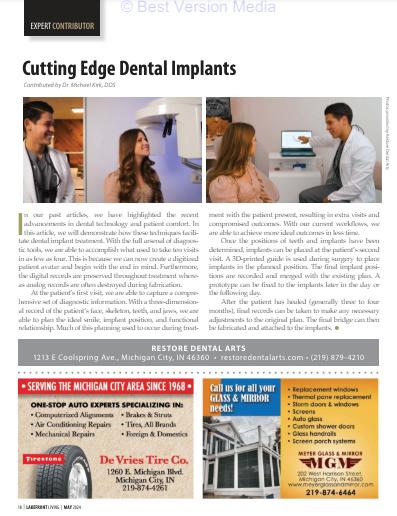
At the patient’s first visit, we are able to capture a comprehensive set of diagnostic information. With a three-dimensional record of the patient’s face, skeleton, teeth, and jaws, we are able to plan the ideal smile, implant position, and functional relationship. Much of this planning used to occur during treatment with the patient present, resulting in extra visits and compromised outcomes. With our current workflows, we are able to achieve more ideal outcomes in less time.
Once the positions of teeth and implants have been determined, implants can be placed at the patient’s second visit. A 3D-printed guide is used during surgery to place implants in the planned position. The final implant positions are recorded and merged with the existing plan. A prototype can be fixed to the implants later in the day or the following day.
After the patient has healed (generally three to four months), final records can be taken to make any necessary adjustments to the original plan. The final bridge can then be fabricated and attached to the implants.