Contributed by Dr. David Weber, DDS, FAGD
Dentistry continues to evolve. Our methods, materials, technology, and techniques improve and expand. As our knowledge grows and solutions improve, we are able to tackle increasingly complex problems. While this is undoubtedly a blessing, it also poses a challenge. Dr. Atul Gawande outlines the parallel problem experienced by physicians:
“Our great struggle in medicine these days is not just with ignorance and uncertainty. It’s also with complexity: how much you have to make sure you have in your head and think about. There are a thousand ways things can go wrong.”
In order to meet this challenge and provide elegant solutions to increasingly complex problems, we must employ skillsets beyond what one person can provide. The team-based approach provides a useful framework to tackle greater challenges with more predictability.
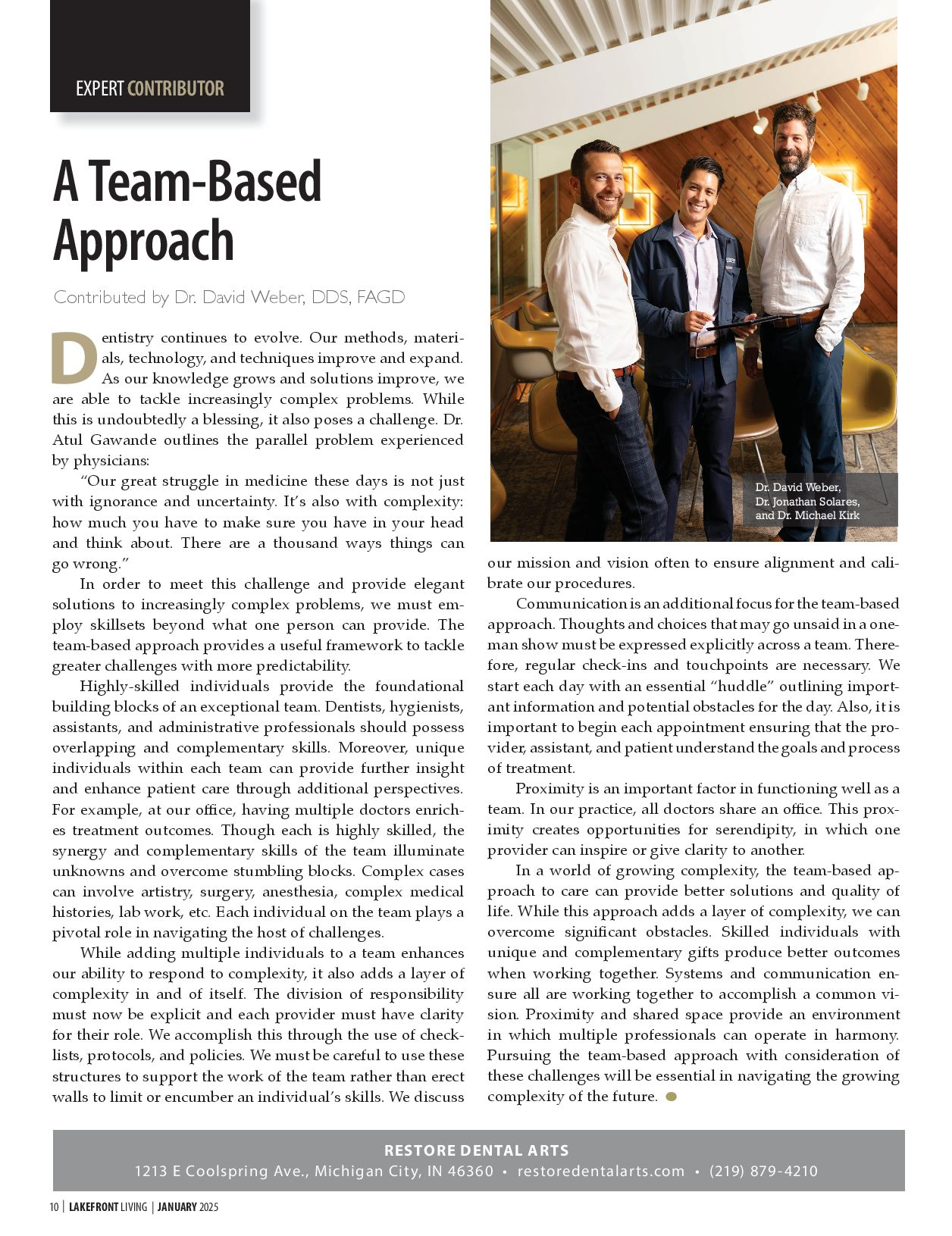
Highly-skilled individuals provide the foundational building blocks of an exceptional team. Dentists, hygienists, assistants, and administrative professionals should possess overlapping and complementary skills. Moreover, unique individuals within each team can provide further insight and enhance patient care through additional perspectives. For example, at our office, having multiple doctors enriches treatment outcomes. Though each is highly skilled, the synergy and complementary skills of the team illuminate unknowns and overcome stumbling blocks. Complex cases can involve artistry, surgery, anesthesia, complex medical histories, lab work, etc. Each individual on the team plays a pivotal role in navigating the host of challenges.
While adding multiple individuals to a team enhances our ability to respond to complexity, it also adds a layer of complexity in and of itself. The division of responsibility must now be explicit and each provider must have clarity for their role. We accomplish this through the use of checklists, protocols, and policies. We must be careful to use these structures to support the work of the team rather than erect walls to limit or encumber an individual’s skills. We discuss our mission and vision often to ensure alignment and calibrate our procedures.
Communication is an additional focus for the team-based approach. Thoughts and choices that may go unsaid in a one-man show must be expressed explicitly across a team. Therefore, regular check-ins and touchpoints are necessary. We start each day with an essential “huddle” outlining important information and potential obstacles for the day. Also, it is important to begin each appointment ensuring that the provider, assistant, and patient understand the goals and process of treatment.
Proximity is an important factor in functioning well as a team. In our practice, all doctors share an office. This proximity creates opportunities for serendipity, in which one provider can inspire or give clarity to another.
In a world of growing complexity, the team-based approach to care can provide better solutions and quality of life. While this approach adds a layer of complexity, we can overcome significant obstacles. Skilled individuals with unique and complementary gifts produce better outcomes when working together. Systems and communication ensure all are working together to accomplish a common vision. Proximity and shared space provide an environment in which multiple professionals can operate in harmony. Pursuing the team-based approach with consideration of these challenges will be essential in navigating the growing complexity of the future.